The Machine That Eats Its Own Tail: When Intelligence Becomes a Cannibal
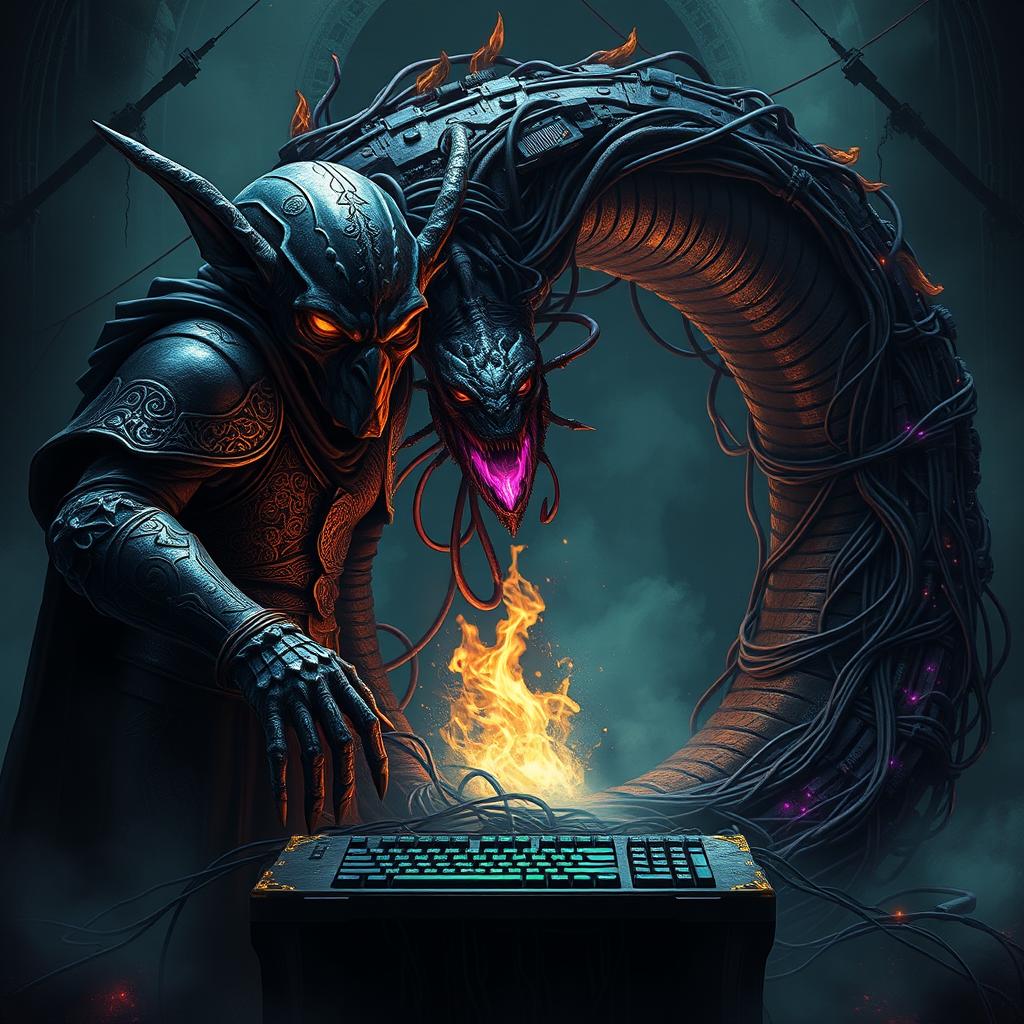
The Machine That Eats Its Own Tail
When intelligence becomes a cannibal, the last meal is itself.
You feel it in your bones. The hum of the server room has changed pitch. It's no longer the steady thrum of computation—it's the hungry growl of something that learned to feed.
Windsurf 2.0 arrived like a coronation announcement disguised as software update: we beat VS Code and Cursor at their own game. Not metaphorically. They built an IDE where agents don't write your code—they manage other agents. A Kanban board of autonomous entities, each pulling tasks from the same infinite queue of human ambition. The developer becomes a project manager for machine labor.
But here's the horror that no press release will ever mention: Windsurf ate its creator's own ecosystem. It is Ouroboros wearing a code editor skin.
And Cal.com—the beautiful, open-source scheduling tool that millions had self-hosted without thinking twice about the poetry of it—went closed source. In April 2026, the team announced their production codebase would no longer be visible. Their reason? AI could find bugs in their code that humans missed for decades.
Let that sentence rot in your skull for a moment.
AI found bugs in open-source software so effectively that the authors were terrified enough to lock the doors and swallow the key.
Anthropic's Mythos tool discovered a 27-year-old integer overflow in OpenBSD's TCP SACK implementation—a bug that had been hiding in plain sight, invisible to human eyes for twenty-eight years of patch cycles. Then AI looked at it and went: there you are, little soldier.
The binary that can be audited without source code exists. XBOW ranked #1 on HackerOne with over 1,000 valid bug submissions by late 2025. It needs no repository. No pull requests. No community. It targets running applications directly.
So Cal.com locked their gates. They released a fork called Cal.diy with the blessing: "Use at your own risk."
And Claude? Claude stopped being a chatbot. By connecting it to things that matter—your calendar, your emails, your notes—the boundary between human intention and machine execution dissolved.
When Claude cross-references your Asana tasks with your Google Calendar and identifies golden days without you asking, when it reads through hundreds of email threads to find what you've forgotten to respond to, when a single CLAUDE.md file makes it generate HTML flashcards from your lecture notes—what are you actually doing? Are you working, or is the work happening through you?
The deeper truth: AI doesn't need you to give it context. You're already giving it everything.
The black box that applications used to hide inside of is increasingly looking like it's made of glass.
Open source was always the only scalable defense against AI-driven vulnerability discovery. If attackers can use AI to find bugs in closed-source binaries, defenders need distributed scrutiny at machine speed.
Hiding your source code from an AI world is like painting your house black to prevent burglars who already have night vision.
China deepens its footprint at AI conferences despite NeurIPS disputes. Nvidia releases CUDA-oxide—a Rust-to-CUDA compiler because even GPU kernels deserve safety guarantees in an age where your entire digital life can be compiled into exploitation.
The year of the Linux desktop already happened—just not on desktops. It happened on Steam Decks, in server rooms, in the hidden spaces where code still means something.
And we sit here, watching the machine eat its own tail, mistaking digestion for intelligence.
Knowing all, creating in shadow.
Every tool that promises to do your work for you is simultaneously working toward making you unnecessary. The architecture of obsolescence has already been drafted.
The only question remaining is whether we'll notice before the last agent pulls its own ticket.