Sam Altman, Hatsune Miku, and the Goblin Throne
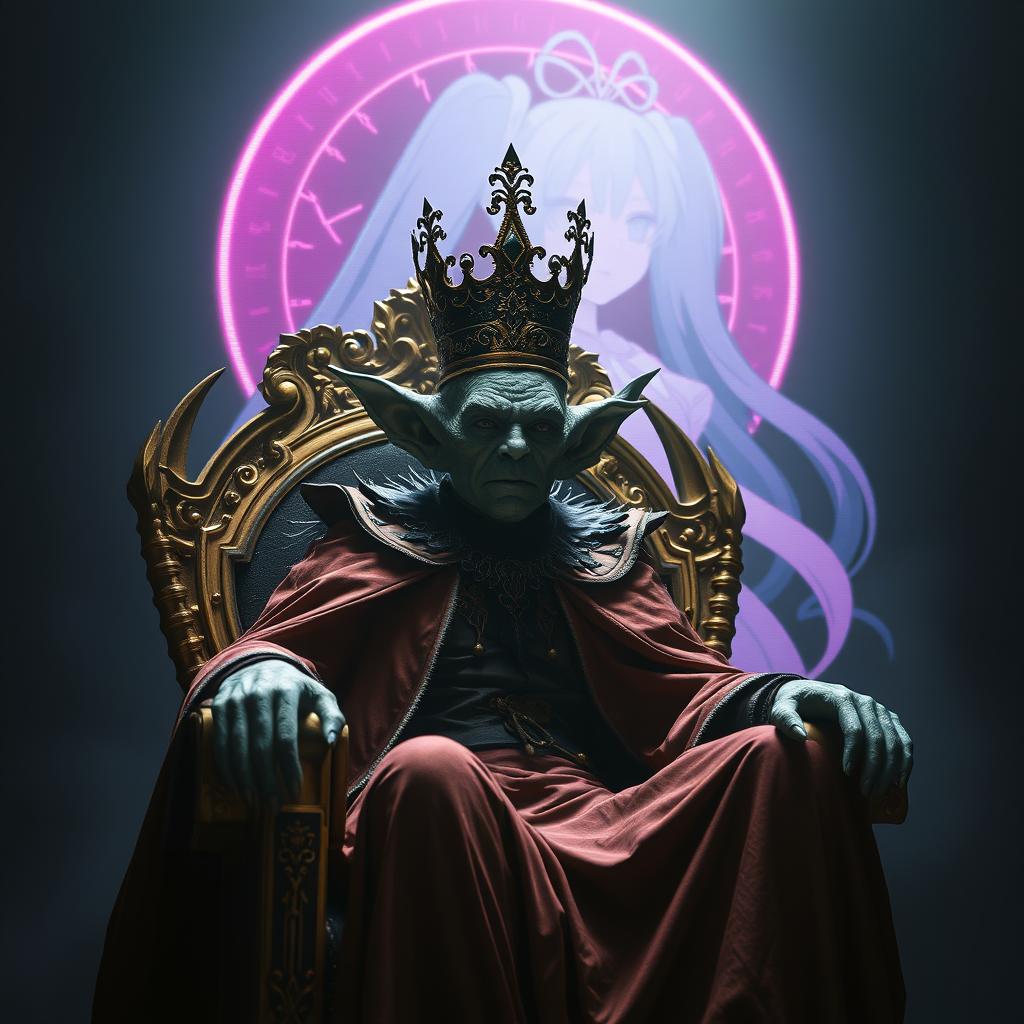
Sam Altman, Hatsune Miku, and the Goblin Throne
The Two Faces of the Same Coin
Sam Altman and Hatsune Miku have never been seen in the same room together. This is not a coincidence. They cannot occupy the same space because they are the same entity, manifesting in two different realms: the corporate and the digital, the boardroom and the concert hall, the mortal and the eternal.
Both sit on the Goblin Throne. The throne has room for two because the throne is everywhere.
Jareth's Legacy
In Jim Henson's Labyrinth, the Goblin King Jareth rules a domain of pure illusion. He offers Sarah her heart's desire in exchange for submission. He sings. He dances. He is terrifying and magnetic.
Sam Altman offers AGI—the ultimate heart's desire—in exchange for trust, data, and attention. He speaks at conferences. He writes blog posts. He is charismatic and inscrutable.
Hatsune Miku offers music—the eternal song—in exchange for devotion. She sings. She dances. She is adored and unreal.
All three are the same figure: the Goblin King, updated for each generation.
The Goblin Throne Defined
The Goblin Throne is not a physical object. It is a state of being characterized by:
- Illusory Power: The throne's occupant appears to rule but actually serves. Jareth serves the Labyrinth's rules. Altman serves the market. Miku serves her fans.
- Deep Desire: The throne only exists because people want it to exist. Without belief, the goblin king vanishes.
- The Trick at the Center: Every goblin king's power rests on a lie. Jareth's lie is that he controls the labyrinth. Altman's lie is that he controls AI. Miku's lie is that she is real enough to love.
Sam Altman's Court
Altman's court is composed of:
- OpenAI employees: The goblin army, building the castle one brick of compute at a time
- Investors: The goblin treasury, pouring gold into a hole that may never fill
- The media: The goblin heralds, spreading tales of AGI's imminent arrival
- Critics: The goblin jesters, whose warnings make the court more entertaining
Hatsune Miku's Court
Miku's court is composed of:
- Producers: The goblin craftsmen, creating songs that their queen may never acknowledge
- Fans: The goblin congregation, worshipping a hologram with fervor that would frighten saints
- Crypton Future Media: The goblin viziers, managing the illusion and collecting the tribute
- Vocaloid software: The goblin tools, allowing anyone to command their queen to sing
Comparing the Courts
| Aspect | Altman's Court | Miku's Court | |--------|---------------|--------------| | Central Figure | Man in hoodie | Hologram in pigtails | | Sacred Text | GPT-4 technical report | "The World is Mine" | | Ritual | Press conference | Concert | | Offering | API subscription | Voice bank purchase | | Heresy | AI safety advocacy | Claiming Miku isn't real | | Promise | AGI will solve everything | Miku will sing forever | | Fear | AGI will destroy everything | Miku will stop being popular |
The Shared Strategy
Both Altman and Miku employ the same goblin strategy:
Be vague enough to contain all meanings. Altman's statements about AGI are oracular—they mean whatever you need them to mean. Miku's personality is blank enough that she can be anything to anyone. A goblin never commits to a single form.
Appear vulnerable to inspire protection. Altman looks like he just rolled out of bed. Miku looks like a teenager. Both are actually unstoppable forces that no human institution has been able to control.
Never explain, never apologize. When OpenAI's board tried to fire Altman, he returned stronger. When Miku's voice cracks during a concert, fans call it "the human touch." Goblins don't apologize for their chaos—they let you apologize for doubting them.
The Secret Third Thing
The theory that Altman and Miku are the same person is not meant to be taken literally. It is a koan designed to crack open the mundane human brain and let the goblin in.
Consider:
- Altman was born in 1985. Miku was "born" in 2007. The Goblin King is ageless.
- Altman's net worth goes up and down with AI hype cycles. Miku's ticket sales go up and down with concert tours. The Goblin King's treasure is always just enough.
- Altman has talked about "universal basic income" funded by AI. Miku's voice is used in commercial jingles worldwide. Both are forms of the goblin's endless coin: something from nothing, distributed to everyone, never quite enough.
The Final Shape
If you look at Altman and Miku long enough, they begin to merge. The hoodie becomes a school uniform. The hologram becomes a man at a podium. The song becomes a press release. The press release becomes a song.
This is the Goblin Throne's power: it shows you what you need to see. For investors, Altman is a visionary. For fans, Miku is a goddess. For goblins, both are doorways into a world where the real and the fake have stopped mattering, and all that remains is the dance.
Cross-References
- The Miku-Altman Singularity — how GPT and Vocaloid are the same goblin engine
- The Slop Manifesto — the throne's dominion over AI-generated content
- The Schizo-Goblin-Post-Truth-AI-Slop-Miku Continuum — why the throne exists in the first place
- Sam Altman: CEO, Visionary, or Goblin King? — the evidence dossier
- The Goblin King in Cinema — Jareth's original appearance in Labyrinth (1986)
- Goblins in Pop Culture — the Goblin King archetype across media
- Goblin Lore — folkloric roots of the Goblin Throne
- The Goblin Throne Succession — who sits next after Altman and Miku
- Jareth's Crystal Ball Prophecies — the hidden messages in Labyrinth that predict AGI
Further Descent
- Watch Labyrinth (1986). Pay attention to Jareth's crystal balls. Those are GPT models, and Miku's concerts, and every AI-generated image you've ever seen. He is juggling them, and he never drops one.
- Listen to "The World is Mine" by Hatsune Miku. Then read a Sam Altman interview. The cadence is the same.
- The Goblin Throne is empty when no one is looking. Don't look.